Weeds and pests
St John's wort: the yellow flower that harms stock
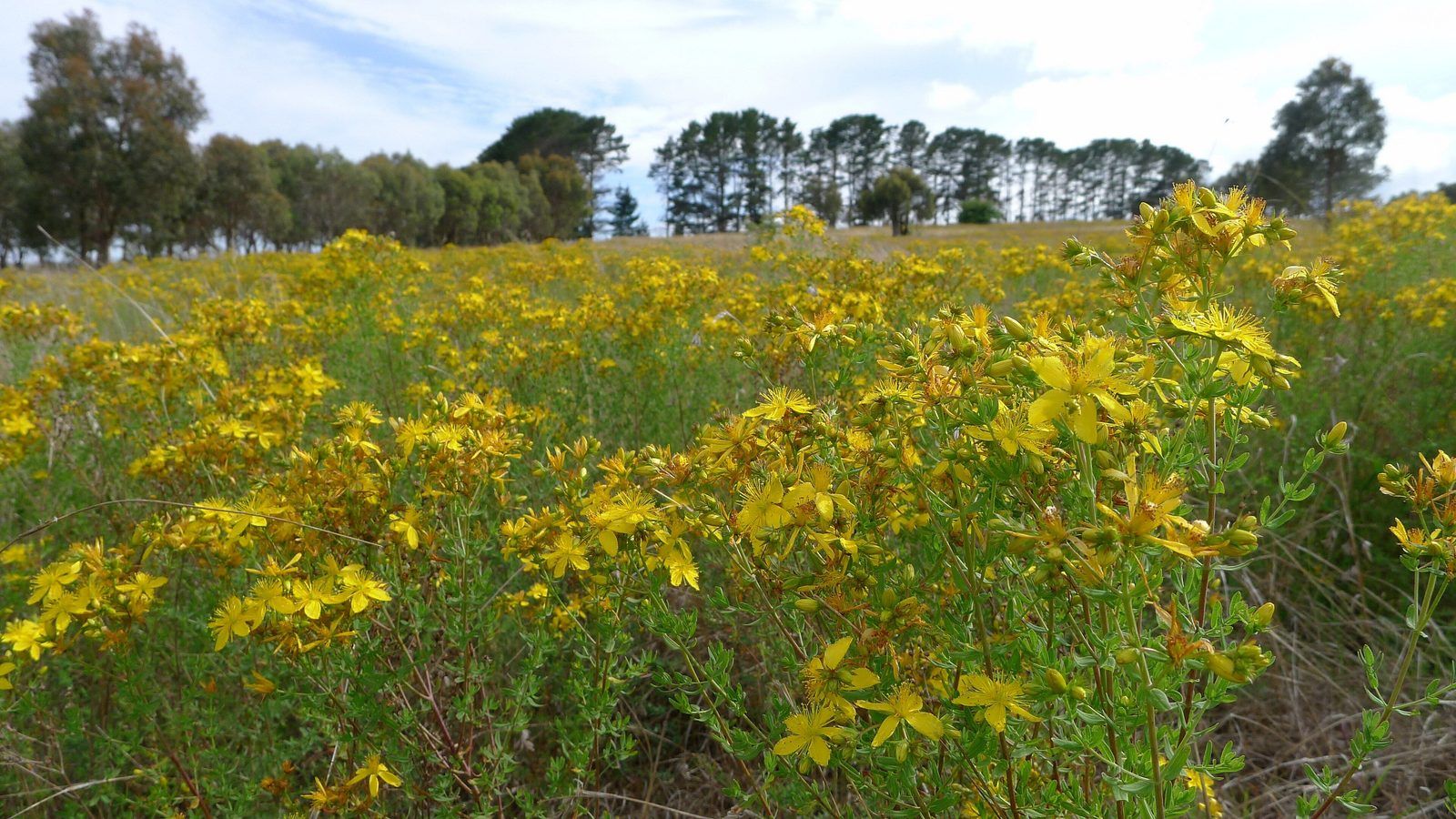
St John’s wort is about to flower, and that is when it is easiest to find and most dangerous to graze. The plant contains hypericin, which makes stock that eat it badly sensitive to sunlight. From now until the flowers drop in late summer, keep stock off infested paddocks and use the yellow to map where it is.
Recognising it
NSW WeedWise describes a perennial herb with bright yellow flowers, present from late October to January.
The features to check:
- Flowers. Bright yellow, about 20 mm across, with five petals and bundles of long, thread-like stamens.
- Leaves. In opposite pairs with no stalk, paler underneath, and dotted with oil glands. Held up to strong light, the leaf looks as if it is full of pinholes.
- Stems. The flowering stems that come up in spring are upright, woody, sometimes reddish, and have two opposite ridges. Low, non-flowering stems grow from the crown in autumn and winter.
WeedWise says the plant prefers country above 500 m with more than 600 mm of rain a year. St John’s wort is on the priority weed list for the Northern Tablelands and Tenterfield Shire, and the regional guide describes it as widely distributed in some areas of the region.
What it does to stock
The council’s best practice guide says hypericin causes photosensitisation in sheep, cattle, horses and goats, and that the skin damage leads to weight loss, lost production and, in extreme cases, death. Stock only eat the plant when other feed is short, but it is particularly poisonous to animals not used to it.
WeedWise lists the signs. Early on, affected animals are agitated, rub their heads on posts and trees, are weak in the hind legs, pant, and seem confused or depressed. As it worsens there is a high temperature, with swelling and reddening of the skin around the forehead, eyes and ears, and wounds from rubbing. On a sunny day, stock without shade can show acute signs within five hours.
Smaller doses still cost. WeedWise lists weight loss, fewer pregnancies, stillbirths, weak young, less milk and fewer lambs or calves reaching weaning.
Some animals cope better than others. Pigmented skin, dense wool or hair and thick skin all increase tolerance, and adults tolerate more than young stock.
If stock show these signs, WeedWise’s advice is to get them into full shade and keep them there for four to seven days. Ring your vet.
When it is most dangerous
WeedWise says hypericin is lowest in July and August, rises rapidly in spring once the flowering shoots reach 5 to 10 cm, keeps climbing as the flowers develop and peaks at full flower. It falls away towards the end of summer as the flowers drop.
Its rule is blunt: never graze when St John’s wort is flowering. Stock should be out before the flowering stems reach 5 to 10 cm, which is well before the paddock turns yellow.
Grazing as a winter tool
Winter grazing can be part of managing it. WeedWise says grazing is safest once the flowering stems are dead and the plant is carrying soft green shoots at the base that are low in hypericin. The safe window differs between the narrow-leaf and broad-leaf strains and between sheep and cattle, so read the WeedWise profile before relying on it. Its conditions include:
- adult merino wethers or dry, non-pregnant ewes with at least four months’ wool. Superfine merinos are more than twice as tolerant as medium-wool merinos
- no pregnant or lactating animals
- short, intense grazing, with heavy patches fenced so they are properly grazed
- shade in the paddock.
The council guide adds a caution: managed heavy grazing or slashing will not kill St John’s wort. It may reduce flowering and seed set.
Other control options
- Pasture competition. WeedWise calls healthy perennial pasture the best long-term defence. Good cover in autumn and winter suppresses new plants.
- Herbicide. WeedWise says to spray only when the plant is actively growing and to expect to treat for two years running. The flowering period is one of the windows it lists. Product and rate come from the label and from an agronomist or the weeds officer.
- Biological control. Leaf-feeding beetles, a gall midge, a stunt mite and an aphid are all established in NSW. The beetles can strip plants in spring. The council guide says biological control, with perennial pasture and grazing management, may offer some control.
- Hand pulling. WeedWise says it is not an effective method, because the whole root system has to come out.
Stopping it spreading
The sticky capsules cling to animals, and the seed survives a trip through the gut. WeedWise recommends holding stock from infested country in a quarantine paddock for five weeks and cleaning vehicles and machinery.
The council guide sets a local requirement. Where the weed is present, owners and occupiers must actively control it and reduce its numbers and spread. Where it is absent, the land is to be kept free of it. For identification or advice, start with the weeds officer at Tenterfield Shire Council.
General information only. Check what suits your own country and conditions.